
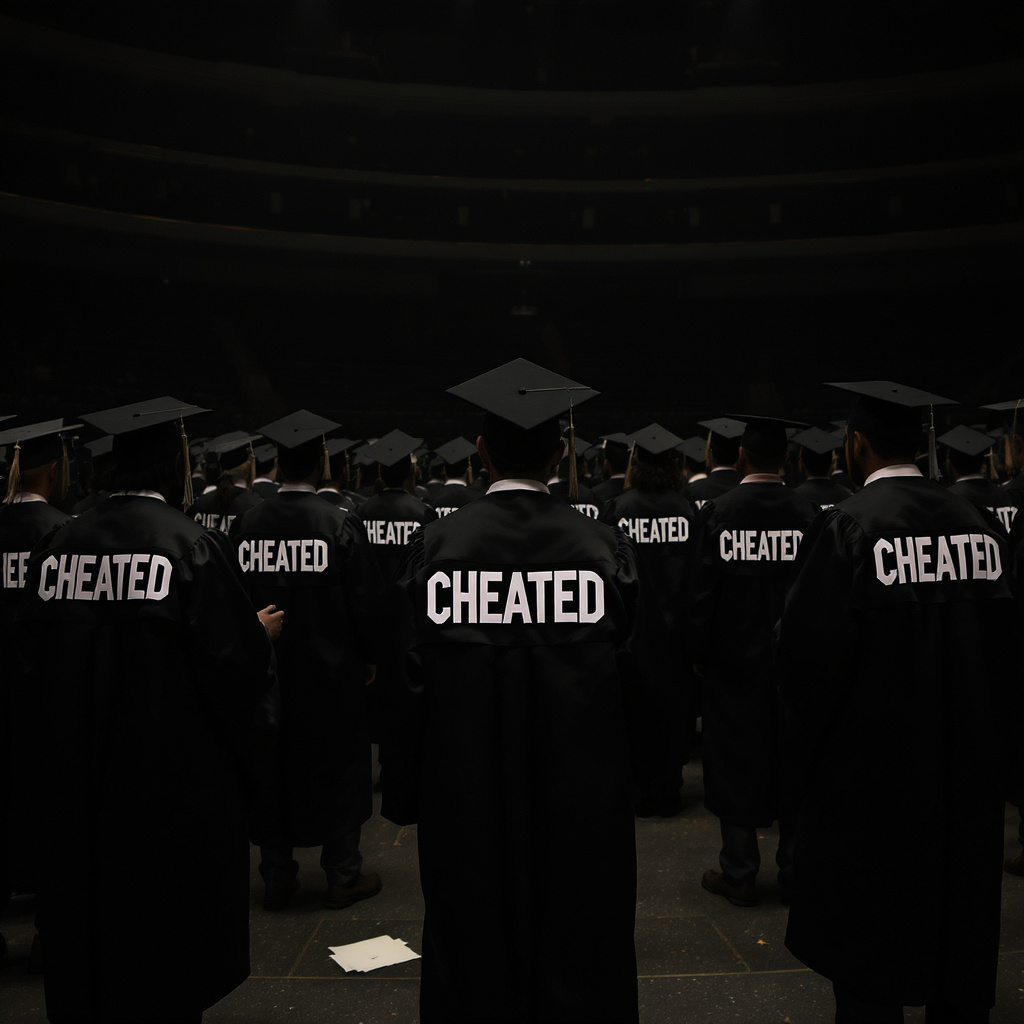
1. The Vicious Cycle of Cheating, Qualifications, and Authority
Academic dishonesty, credential inflation, and a misplaced faith in authority are not merely overlapping issues. They form a self-reinforcing cycle. This cycle undermines real competence. Superficial indicators of achievement—degrees, certifications, “expert” titles—too often substitute for actual ability.
Cheating is pervasive and surging. Decades of research show that students cheat because they face intense pressure. Digital tools and loopholes have made it easier to cheat undetected. This compromises the integrity of academic qualifications.
Inflated qualifications devalue real merit. With a flood of graduates, even basic jobs now need degrees, pushing people to accumulate certifications of dubious relevance. This credential creep elevates the value of the degree itself over what it signifies—actual readiness or skill.
Blind deference to qualifications crowds out competence. When institutions and employers value degrees—and so-called experts—instead of actual performance, they reward qualifications, not real ability. This creates a dangerous feedback loop: cheating becomes beneficial; inflated backgrounds multiply; credibility frays; so reliance on qualifications deepens.
2. Why This Matters—Societal & Institutional Dependence and Disownment of Responsibility.
Credential inflation is more than a corporate HR headache. It has serious societal consequences:
Education is losing value. Degrees that once symbolized competence are now often just access tokens to jobs and status. Cheating threatens trust. As qualifications lose authority, trusting professionals like engineers, teachers, or doctors becomes difficult. Yet, society relies implicitly on that trust. Higher costs, stagnant returns. Escalating tuition and student debt pile onto degrees that do not improve employability or performance.
3. Toward a Harder Reasoned Fix.
Let’s skip the sugar-coating. Here’s what needs to change:
Educational Institutions Must:
Enforce integrity actively. Tighten honor codes. Detecting academic fraud is especially challenging now, with AI tools like ChatGPT making cheating easier and more challenging to detect. Shift from credentialism to ability. Design assessments that evaluate skills, rather than just memorizing and repeating. Return focus to genuine learning. Students shouldn’t chase grades; they should cultivate real understanding and know-how.
Employers Must:
Ditch the degree fetish. Evaluate candidates based on demonstrated ability, including portfolios, problem-solving, and apprenticeships, rather than relying on credential check boxing.
Individuals Must:
Think critically. Question experts. Develop independent judgment rather than defaulting to credential-based trust.
The Framework Must:
Diversify the institutional ecosystem. We don’t need a single institution to handle learning, training, innovation, and credentialing. Let apprenticeship models, independent labs, vocational schools, and libraries thrive alongside universities.
4. Final Word (Straight-Talking & Advanced-Thinking)
This tangled web isn’t an accident—it’s systemic. Cheating proliferates because qualifications matter more than substance. Certifications proliferate because degrees are easy signals. Signals matter because performance doesn’t get rewarded enough.
We need radical restructuring:
Rebuild trust by rewarding competence, not qualifications. Enforce integrity by making cheating costly—not just dishonorable. Encourage institution and societal diversity—not bureaucratic conformity.
Don’t buy the claim that a degree equals competence. It once signaled readiness; today, it’s often just participation. Let’s rewrite that expectation—demand more, and give the privilege of credibility only where evidence backs it.
References:
1. “Academic Dishonesty in Graduate Business Programs: Prevalence, Causes, and Proposed Action”
- Authors: Donald L. McCabe, Kenneth D. Butterfield, Linda Klebe Treviño (2006)
- Summary: A seminal study on cheating prevalence in MBA programs, revealing cultural and institutional factors influencing dishonesty.
- Link: DOI
2. “Cheating in Academic Institutions: A Decade of Research”
- Authors: Donald L. McCabe, Linda Klebe Treviño (1993)
- Summary: Early meta-analysis on cheating trends in higher education, highlighting motivations like peer behavior and perceived fairness.
- Link: JSTOR
3. “Cheating in College: Why Students Do It and What Educators Can Do About It” (Book)
- Authors: Donald L. McCabe, Linda Klebe Treviño, Kenneth D. Butterfield (2012)
- Summary: Expanded research on cheating drivers, including technology, pressure, and institutional policies.
- Link: Amazon
4. “Academic Integrity in the 21st Century: A Teaching and Learning Imperative” (Report)
- Publisher: International Center for Academic Integrity (ICAI)
- Summary: Surveys global cheating trends, including contract cheating and tech-enabled dishonesty.
- Link: ICAI Resources
5. “The Role of Self-Regulated Learning in Contextual Cheating”
- Authors: Eric M. Anderman, Tripp Griesinger, Gloria Westerfield (1998)
- Summary: Explores psychological factors (e.g., motivation, self-efficacy) linked to cheating.
- Link: DOI
6. “Digital Devices and Student Dishonesty: A Meta-Analysis”
- Authors: Tricia Bertram Gallant (2020)
- Summary: Examines how smartphones and online tools have transformed cheating methods.
- Link: SAGE Journals
7. “Contract Cheating: A Survey of Australian University Students”
- Authors: Guy J. Curtis, R. Slade (2018)
- Summary: Landmark study on contract cheating (paying others to complete work) among students.
- Link: DOI
8. “Cheating Across Cultures: Insights for Psychology, Education, and Policy”
- Authors: David A. Rettinger, Anastasiya A. Lipko (2007)
- Summary: Cross-cultural analysis of cheating norms and attitudes.
- Link: ResearchGate
9. “Academic Dishonesty: An Educator’s Guide”
- Publisher: Educational Testing Service (ETS)
- Summary: Policy-focused report on prevention strategies and ethical frameworks.
- Link: ETS Report
10. “The Internet and Academic Cheating: A Meta-Analysis”
- **Authors**: Brian K. Payne, Chrizanne E. Nantz (2016)
- **Summary**: Reviews how online resources facilitate cheating.
- **Link**: [DOI](https://doi.org/10.1080/01930826.2015.1113030)
About The Author

Discover more from Milford N.H. Voice
Subscribe to get the latest posts sent to your email.